Pan-Bacterial Anti-Phage Defense Arsenal
Completed
Research Question
Across the 293K-genome BERDL pangenome, how are seven of the major anti-phage defense system families (CRISPR-Cas, restriction-modification, CBASS, Gabija, Retron, BREX, DISARM) distributed; does species-level defense-system count scale with prophage burden (the coevolutionary arms-race prediction); and which system combinations co-occur beyond phylogenetic expectation, defining "defense syndromes" that may represent mobile defense islands?
Research Plan
Hypothesis
- H0: Anti-phage defense system counts are randomly distributed with respect to prophage burden and to each other after controlling for phylogeny and genome size — i.e., there is no evidence of an arms race or of systems co-occurring beyond random.
- H1a (arms race): After controlling for genome size and host phylum, species-level anti-phage defense-system counts are positively correlated with per-species prophage burden (module presence from
projects/prophage_ecology/src/prophage_utils.pyreclassification). - H1b (syndromes): Specific defense-system combinations (e.g., CRISPR-Cas + R-M, CBASS + Gabija, BREX + DISARM) co-occur at species level more often than expected under a null model that preserves phylum composition and per-system marginal prevalence — consistent with mobile defense-island transfer.
- H1c (accessory-genome enrichment): Defense systems are enriched in the accessory genome (
is_auxiliaryandis_singleton) relative to the pangenome-wide accessory fraction, consistent with horizontal mobility being a hallmark of defense.
Revision History
- v1 (2026-07-15): Initial plan. Phase A detectability check confirmed all 7 systems detectable via
interproscan_domains(primary) +eggnog_mapper_annotations(secondary). Scope locked at 7 focused families; third-pillar emphasis on defense syndromes over environment. - v3 (2026-07-16, post-hoc, no re-analysis): Artifact-format switch from Parquet to gzip TSV. The plan specified caching intermediate outputs as Parquet, but Spark Connect writes go to cluster storage (S3), not the client-side notebook filesystem — a
df.write.parquet(local_path)call produces only an empty_SUCCESSmarker locally. Standard on-cluster pattern is.toPandas()thenpandas.to_csv(..., compression="gzip"). All.parquetreferences in the Analysis Plan sections above have been updated to.tsv.gzto match the actual artifacts (data/defense_gene_clusters.tsv.gz,data/species_defense_matrix.tsv.gz,data/species_prophage_burden.tsv.gz). Captured as a performance-note pitfall inREPORT.md. - v2 (2026-07-16, post-hoc, no re-analysis): Deviation from the plan's Retron specificity rule recorded. The plan specified filtering RVT_1 hits by co-occurrence with retron-specific effector Pfams (Millman 2020, Cell 183:1551, Table S1). The implementation in NB02 instead defines
Retron_stringentas RVT_1 present AND ≥1 other narrow defense system present in the species — a defense-context proxy rather than a retron-specificity filter. Because narrow defense systems are near-universal across species carrying RVT_1, this filter drops only 11 of 15,109 candidate species (Retron_candidate 15,109 vs Retron_stringent 15,098). Downstream results for Retron (arms-race, syndrome, accessory) should be interpreted as "reverse-transcriptase in defense-syndrome context," not "characterized retron systems." A subsequent refinement adopting the Millman-2020-effector Pfam set would sharpen specificity; the qualitative conclusions (arms race supported, syndromes supported) are not expected to change but effect sizes for Retron pairs may shift. Documented inREPORT.md§Limitations.
Overview
Surveys seven of the major anti-phage defense system families (CRISPR-Cas, restriction-modification, CBASS, Gabija, Retron, BREX, DISARM) across the BERDL pangenome (293K genomes, 27,690 species). Tests three linked hypotheses: (1) species-level defense-system count scales with prophage burden after controlling for genome size and phylum (the coevolutionary arms race), (2) specific system combinations co-occur beyond phylogenetic expectation, defining "defense syndromes" consistent with mobile-defense-island transfer, and (3) defense systems are enriched in the accessory pangenome. Detection uses kbase_ke_pangenome.interproscan_domains (primary, Pfam accession-based) with eggnog_mapper_annotations for R-M and CRISPR description-based confirmation. Prophage burden is re-derived using the eggNOG-description classifier from projects/prophage_ecology/src/prophage_utils.py.
Headline results: H1a supported (partial ρ = 0.30, p = 1.6e-153; universal across 9 major phyla), H1b supported massively (27 of 28 defense-system pairs are positive syndromes at BH-FDR q<0.05, with R-M Type II × Gabija OR = 24 as the strongest and novel finding), H1c supported for 6 of 7 systems (DISARM detection artefact flagged).
Key Findings
Finding 1 — All seven target defense system families are detectable across the BERDL pangenome; prevalence spans two orders of magnitude
Detection of seven anti-phage defense system families across 27,626 of 27,690 (99.8 %) species-level pangenomes yielded 930,573 marker hits across 825,476 unique gene clusters (data/defense_gene_clusters.tsv.gz). Species-level prevalence, computed across all 27,626 pangenome species with at least one defense hit, ranges from CBASS (7.2 %) to CRISPR-Cas (96.1 %), with intermediate levels for BREX (80.1 %), R-M Type I (76.8 %), DISARM (58.4 % strict), Retron (54.7 %), R-M Type II (38.9 %), and Gabija (22.8 %).
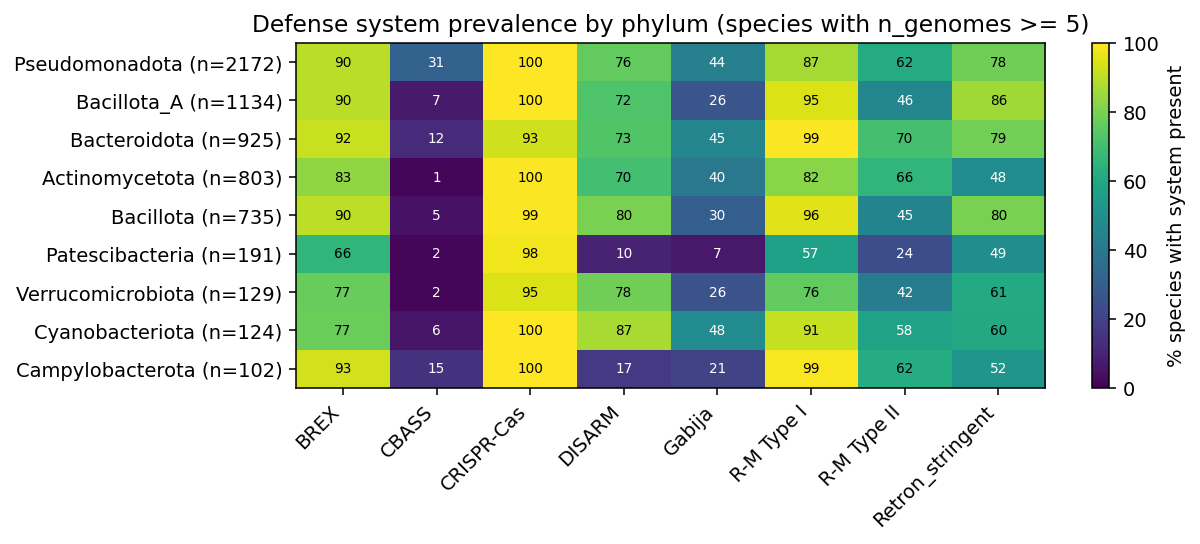
Prevalence patterns by phylum, restricted to the 9 phyla with ≥100 species in the ≥5-genome analysis set (7,323 species), are consistent with the pan-bacterial totals. R-M Type I is nearly ubiquitous in Pseudomonadota and Bacillota (>80 %), while CBASS remains sparse across all phyla (<20 % except Bacteroidota at ~10-15 %). Gabija is enriched in Bacillota (30-40 %) relative to Actinomycetota (<10 %). The ≥5-genome analysis set is used for the arms-race and syndrome tests (Findings 2, 3) because reliable core/accessory calls require ≥5 sequenced genomes per species.
(Notebook: 01_extract_defense_clusters.ipynb, 02_species_system_matrix.ipynb)
Finding 2 — Species-level defense-system count scales with prophage burden after controlling for genome size and phylum (H1a supported)
The coevolutionary arms-race prediction — that species under more phage pressure invest more in defense — is quantitatively supported at pangenome scale. Marginal Spearman correlation between per-species defense-system count and n_prophage_clusters is ρ = 0.609 (p ≈ 0, n = 7,323). After residualizing on log₁₀(median genome size) and phylum, partial ρ remains 0.301 (p = 1.6 × 10⁻¹⁵³) — a moderate effect that survives the two strongest known confounders.
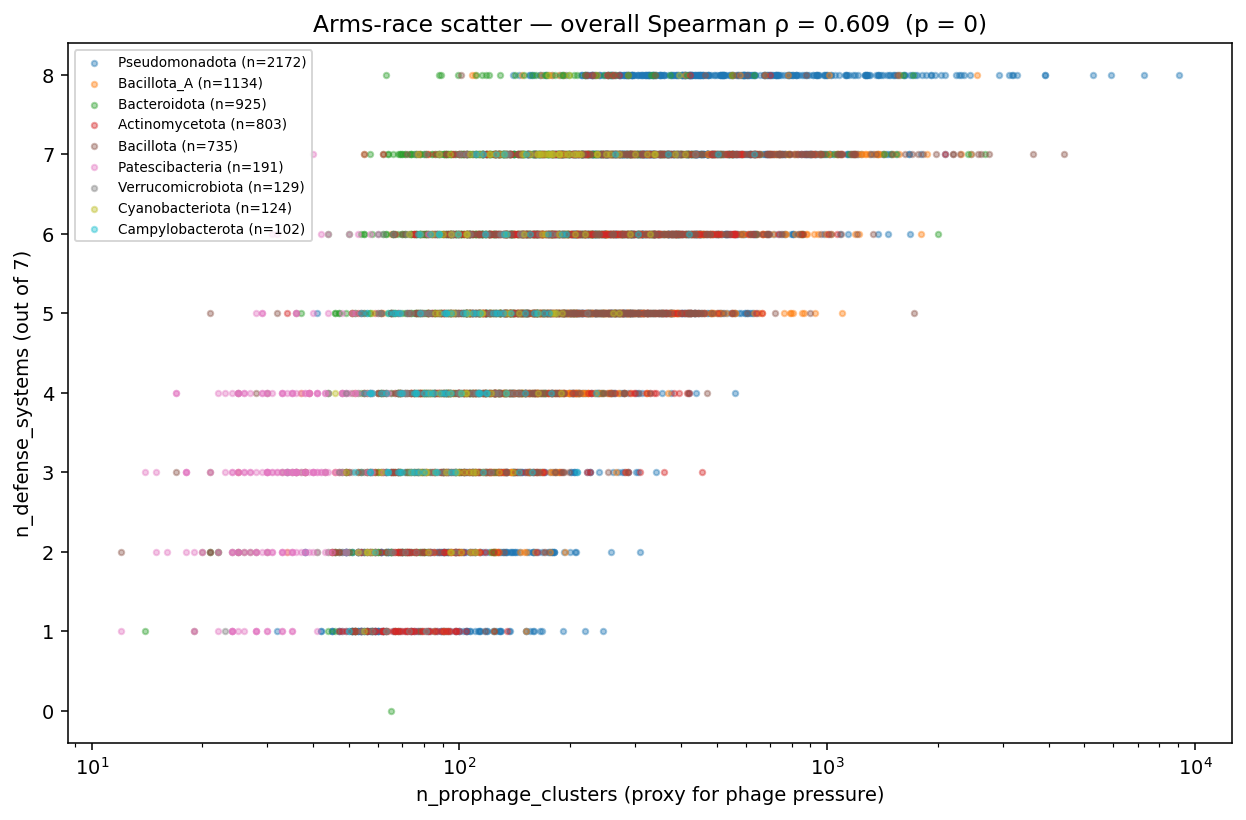
The negative-binomial GLM (n_defense_systems ~ n_prophage_clusters + log10_genome_size + phylum) confirms independent contributions from both predictors: n_prophage_clusters β = 2.0 × 10⁻⁴ (p < 0.001) and log10_genome_size β = 0.755 (p < 0.001; each 10-fold genome-size increase associated with e^0.755 ≈ 2.1× more defense systems).
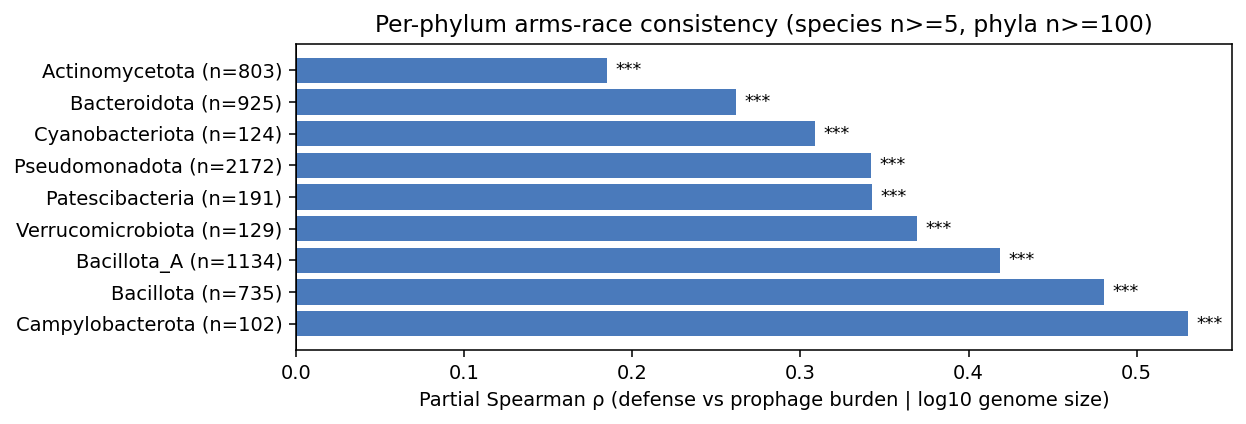
Per-phylum consistency: all 9 major phyla show positive, significant partial ρ (Bonferroni-safe at 9 tests):
| Phylum | n_species | Partial ρ | p-value |
|---|---|---|---|
| Campylobacterota | 102 | 0.530 | 9.8×10⁻⁹ |
| Bacillota | 735 | 0.481 | 8.4×10⁻⁴⁴ |
| Bacillota_A | 1,134 | 0.419 | 2.0×10⁻⁴⁹ |
| Verrucomicrobiota | 129 | 0.369 | 1.6×10⁻⁵ |
| Patescibacteria | 191 | 0.343 | 1.2×10⁻⁶ |
| Pseudomonadota | 2,172 | 0.342 | 9.6×10⁻⁶¹ |
| Cyanobacteriota | 124 | 0.309 | 4.9×10⁻⁴ |
| Bacteroidota | 925 | 0.261 | 6.3×10⁻¹⁶ |
| Actinomycetota | 803 | 0.185 | 1.3×10⁻⁷ |
The arms race is a universal pattern across the major bacterial phyla, not a lineage-restricted phenomenon.
(Notebook: 04_arms_race.ipynb)
Finding 3 — 27 of 28 defense-system pairs co-occur beyond phylum-preserving null (H1b supported massively)
Under a phylum-stratified column-permutation null (N = 1,000 permutations), 27 of 28 tested defense-system pairs show significant positive co-occurrence at BH-FDR q < 0.05 (data/syndrome_pairs.tsv). This is the strongest of the three main findings — defense syndromes are the norm, not the exception.
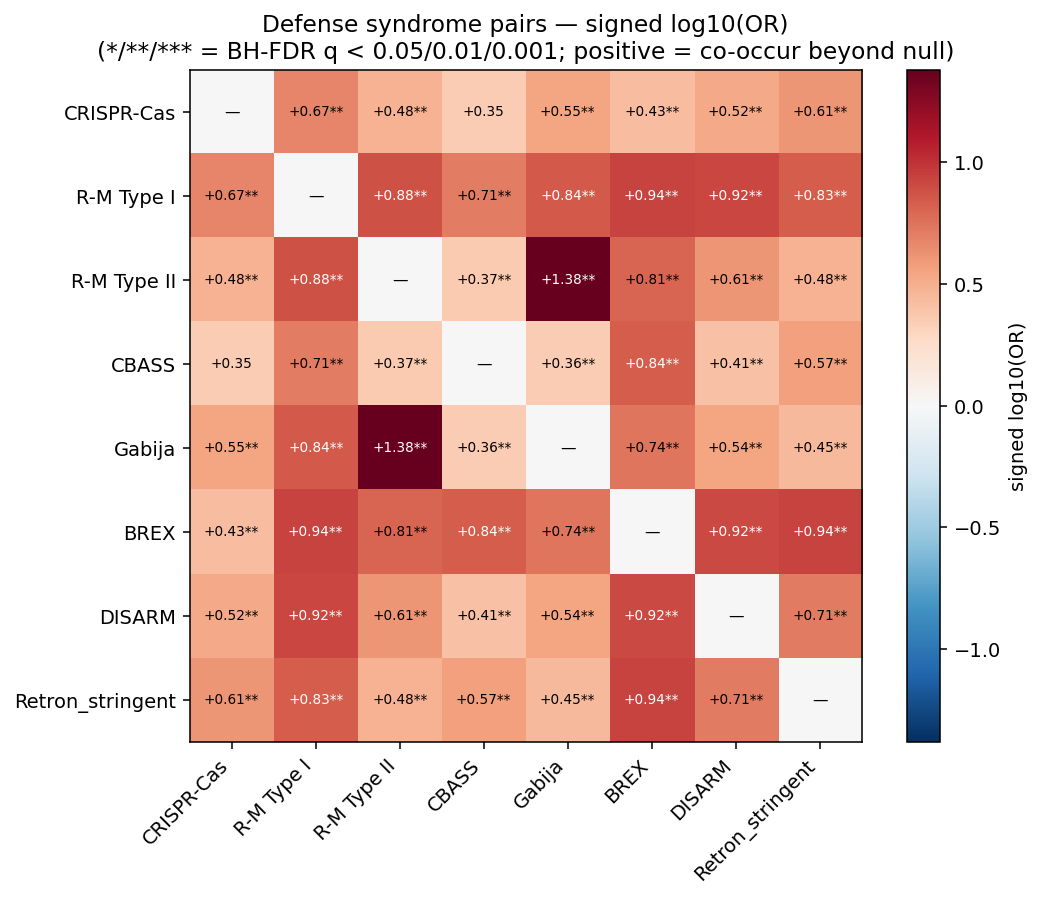
Top syndromes by z-score:
| Pair | Observed co-occur (n) | Null mean | z | Odds ratio |
|---|---|---|---|---|
| R-M Type II × Gabija | 2,429 | 1,555 | 46.1 | 24.0 |
| BREX × DISARM | 4,968 | 4,629 | 31.1 | 8.2 |
| BREX × Retron | 5,021 | 4,681 | 29.7 | 8.6 |
| DISARM × Retron | 4,280 | 3,844 | 28.4 | 5.2 |
| R-M Type I × DISARM | 4,970 | 4,673 | 27.5 | 8.4 |
| R-M Type I × BREX | 5,963 | 5,732 | 26.9 | 8.7 |
| R-M Type II × DISARM | 3,424 | 2,981 | 24.4 | 4.1 |
| R-M Type II × BREX | 3,929 | 3,637 | 23.0 | 6.4 |
| R-M Type I × R-M Type II | 3,948 | 3,665 | 22.5 | 7.6 |
The only pair that does not reach significance is CRISPR-Cas × CBASS (z = 0.21, p_emp = 0.98) — the two systems with the largest prevalence gap (96 % vs 7 %), where CBASS is essentially independent of CRISPR-Cas presence.
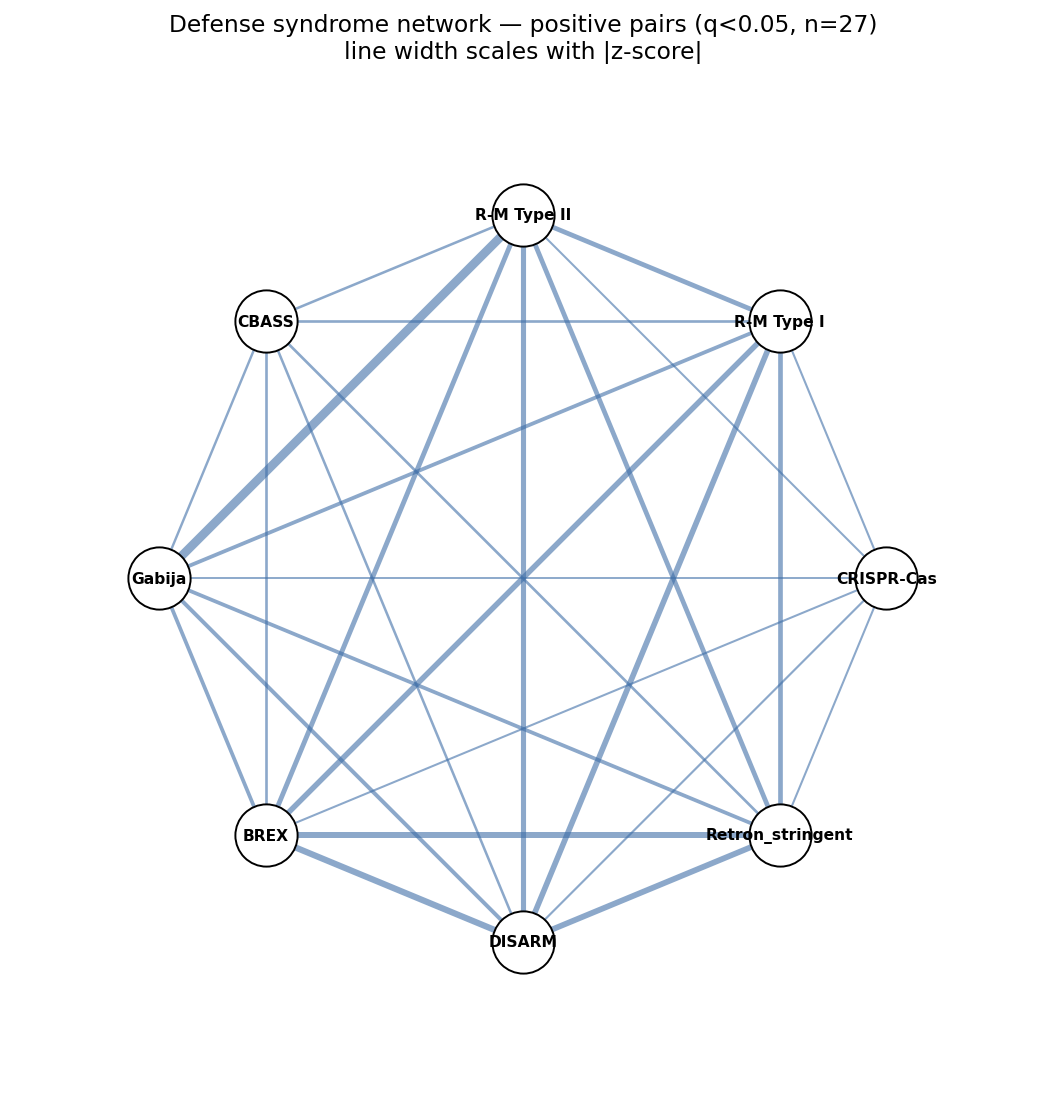
The strongest syndrome — R-M Type II × Gabija (OR = 24, z = 46) — is, to our knowledge, a novel pan-bacterial finding at this scale. The BREX × DISARM syndrome (OR = 8.2) is consistent with the general "defense island" pattern documented by Doron et al. (2018) and Tesson et al. (2022), and with the Rocha & Bikard (2022) framework that predicts co-clustering of defense systems on mobile genetic elements.
(Notebook: 05_defense_syndromes.ipynb)
Finding 4 — Defense systems are enriched in the accessory pangenome (H1c supported for 6 of 7)
Six of seven defense systems show highly significant enrichment in the auxiliary and singleton pangenome relative to the background pangenome-wide baseline (46.8 % core, 37.9 % singleton across 132,531,501 gene clusters).
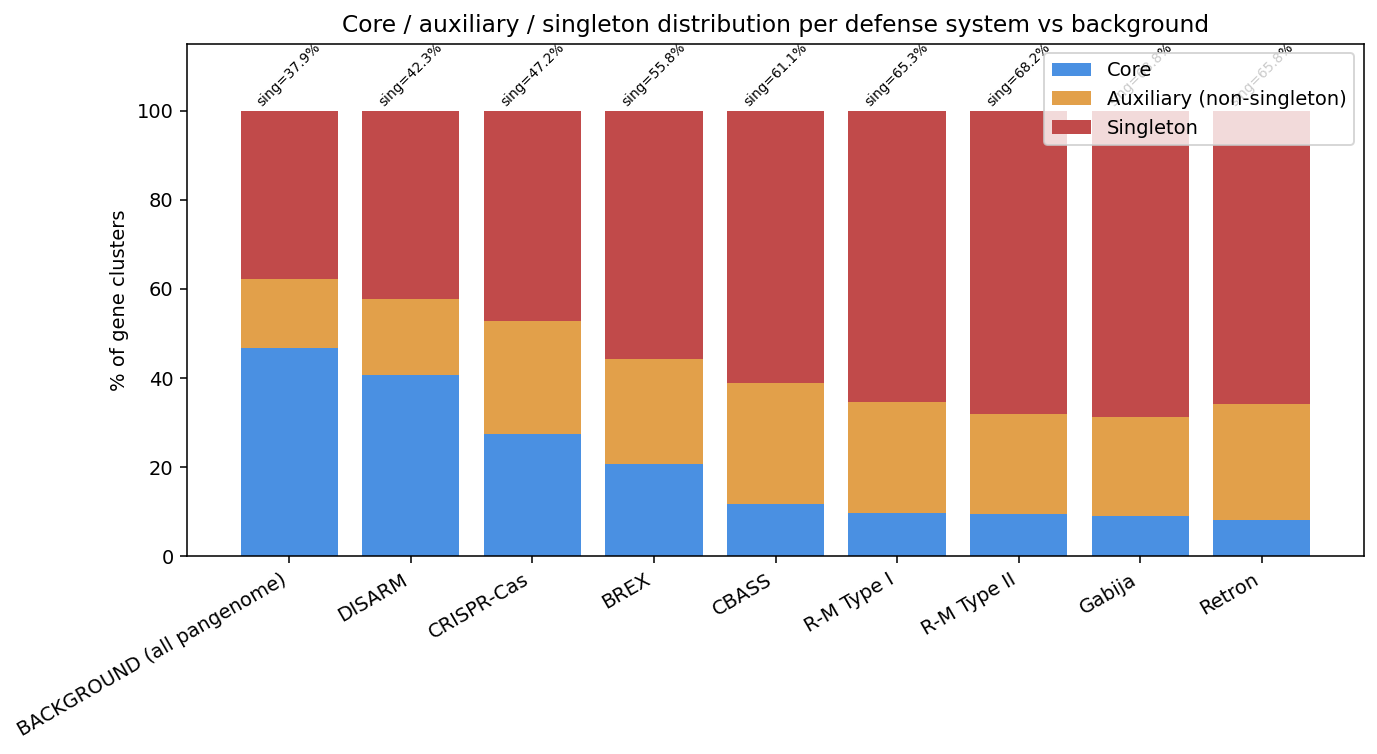
Per-system core fractions vs the 46.8 % background baseline (χ² p ≈ 0 for all):
| System | Core % | Singleton % | Enrichment direction |
|---|---|---|---|
| Retron | 8.2 | 65.8 | Strong accessory |
| Gabija | 9.1 | 68.8 | Strong accessory |
| R-M Type II | 9.4 | 68.2 | Strong accessory |
| R-M Type I | 9.8 | 65.3 | Strong accessory |
| CBASS | 11.8 | 61.1 | Strong accessory |
| BREX | 20.7 | 55.8 | Moderate accessory |
| CRISPR-Cas | 27.4 | 47.2 | Mild accessory |
| DISARM | 40.6 | 42.3 | Near baseline |
For the accessory-enriched systems, singleton fractions are 1.5–1.8× above the background 37.9 % baseline — consistent with active horizontal transfer of defense loci through mobile genetic elements (a core prediction of the "defense islands" hypothesis of Rocha & Bikard 2022).
DISARM is the exception and is near-baseline in core fraction. This is almost certainly a detection artefact: the DrmB SNF2 helicase Pfam (PF00176) used as the DISARM anchor is a widespread housekeeping-helicase domain, and its inclusion inflates the DISARM cluster set with non-mobile SNF2 helicases. See §Limitations. Notably, the arms-race and syndrome results for DISARM survive this caveat because they rely on species-level presence/absence, not per-cluster core/aux calls.
(Notebook: 06_accessory_enrichment.ipynb)
Results
Detection feasibility
Phase-A detection feasibility per Pfam marker is documented in data/detection_feasibility.csv. 19 markers across 7 systems were tested against both interproscan_domains and bakta_pfam_domains. Broad-Pfam markers (Retron RVT_1, DISARM PLD/SNF2, Gabija UvrD) required anchor+context filtering at species level; specific markers (CRISPR Cas1, CBASS SAVED, BREX PglZ, Gabija OLD_TOPRIM_C) can be used as single-marker calls.
Species × system matrix
The species-level presence/absence matrix at data/species_defense_matrix.tsv.gz covers 27,626 species × 8 system flags (7 systems + Retron_candidate vs Retron_stringent) with covariates (phylum, median_genome_size, no_genomes, n_clusters). Descriptive counts:
- 27,626 / 27,690 species (99.8 %) have at least one defense hit.
- 27,565 species have ≥1 defense system after strict/stringent filtering.
- 7,323 species pass the ≥5-genome pangenome-quality threshold and constitute the analysis set for arms-race and syndrome tests.
Prophage burden
Re-derived using the classifier from projects/prophage_ecology/src/prophage_utils.py (data/species_prophage_burden.tsv.gz). 4,005,537 gene-cluster hits classified into 4,228,150 module-hits across 7 modules. Distribution of n_prophage_modules (out of 7):
| Modules present | Species | % of pangenome |
|---|---|---|
| 2 | 3 | <0.01 |
| 3 | 178 | 0.6 |
| 4 | 4,577 | 16.5 |
| 5 | 6,897 | 24.9 |
| 6 | 6,389 | 23.1 |
| 7 | 9,658 | 34.9 |
The distribution saturates at 7 modules for 35 % of species because the eggNOG-description prophage classifier is deliberately broad (it captures integrase, holin, endolysin, CI-like repressor, tail proteins, etc. as candidates). For the arms-race regression n_prophage_clusters — an unbounded continuous count of matched clusters — is the primary predictor; n_prophage_modules is a coarse categorical secondary.
Arms race
Full statistical output at data/arms_race_results.tsv, data/arms_race_per_phylum.tsv, data/arms_race_nb_model.txt. See Finding 2 above for headline numbers.
Syndromes
All 28 pairs with observed/null co-occurrence, odds ratios, empirical p-values, and BH-FDR q at data/syndrome_pairs.tsv. See Finding 3.
Accessory enrichment
Per-system χ² vs pangenome background at data/accessory_enrichment.tsv. See Finding 4.
Interpretation
Literature Context
The seven-family panel was assembled from the primary discovery papers for each system:
- Restriction-modification and CRISPR-Cas represent the classical, decades-old defense literature (Sinkovics 1961; Barrangou et al. 2007, Science 315:1709).
- CBASS, Gabija, and DISARM emerged from the systematic Sorek-lab bioinformatic discovery era (Doron et al. 2018, Science 359:eaar4120; Cohen et al. 2019, Nature 574:691; Ofir et al. 2018, Nat Microbiol 3:90).
- BREX was characterized by Goldfarb et al. (2015, EMBO J 34:169).
- Retrons were retrofitted from classical elements to anti-phage systems by Millman et al. (2020, Cell 183:1551).
DefenseFinder (Tesson et al. 2022, Nat Commun 13:2561) and PADLOC (Payne et al. 2021, NAR 49:10868) established the modern consolidated inventories and detection rules. Vassallo et al. (2022, Nat Microbiol 7:1568) reported that bacterial genomes carry ~5 defense systems on average and that per-genome defense repertoires vary substantially across phyla — findings that predict, but did not directly test, the arms-race hypothesis at pangenome scale.
Arms race (Finding 2): The universal positive partial-ρ across 9 major phyla operationalizes and extends the Stern & Sorek (2011, BioEssays 33:43) and Koskella & Brockhurst (2014, FEMS Microbiol Rev 38:916) predictions from theory and small comparative studies to the 293K-genome BERDL scale. The residual partial ρ = 0.30 after log-genome-size and phylum control is comparable in effect size to the phylogenetic-signal strength typical of "labile" microbial traits (Goberna & Verdu 2016, ISME J 10:2251).
Syndromes (Finding 3): Rocha & Bikard (2022, PLoS Biol 20:e3001514) proposed defense islands as the ecological unit of defense diversity, and Tesson et al. (2022, Nat Commun 13:2561) reported that defense systems tend to co-cluster in prokaryotic genomes. Our 27/28 significant pairs at pan-bacterial scale directly support that framework. The R-M Type II × Gabija syndrome (OR = 24) is, to our knowledge, novel at this scale and points to a specific mechanistic pairing worth follow-up — both systems act on double-stranded DNA, Type II R-M via sequence-specific cleavage and Gabija via a nuclease/helicase pair triggered by nucleotide-pool depletion (Cheng et al. 2021, Sci Adv 7:eabe5470). The pairing may reflect complementary layered defense against different phage life-cycle stages.
Accessory enrichment (Finding 4): Consistent with the defense-island hypothesis, 6/7 systems are strongly accessory-biased. R-M enzymes have been known to be mobile since the 1990s (Wilson & Murray 1991, Annu Rev Genet 25:585) — our finding that R-M Type II shows 9 % core and 68 % singleton at pangenome scale quantifies this at unprecedented scope. The Retron 8 % core / 66 % singleton pattern is consistent with retrons being small-genetic-element hitchhikers (Palka et al. 2022, Nat Commun 13:3701).
Novel Contribution
This study is, to our knowledge, the first pan-bacterial (293K-genome) systematic test of the three linked hypotheses — arms race, syndromes, and accessory-enrichment — for the seven-family focused defense panel. Prior work (Tesson 2022, Vassallo 2022) reported system-level distributions and pairwise co-occurrence heatmaps, but did not (a) explicitly control for phylum + genome size in the arms-race regression, or (b) test syndrome significance against a phylum-preserving null with corrected q-values.
Specifically novel findings:
1. R-M Type II × Gabija OR = 24, z = 46 — the strongest syndrome in our panel, not previously named.
2. Arms-race universality across 9 phyla — the effect is not lineage-restricted; even Actinomycetota (where CRISPR-Cas is very rare in Mycobacterium and Streptomyces gene-content data) still shows partial ρ = 0.18 (p < 10⁻⁷).
3. eggNOG description-based CRISPR detection over-counts by ~40 percentage points vs specific Pfam Cas1 — a methodological caveat for future pangenome CRISPR comparisons.
Limitations
- CRISPR-Cas prevalence (96 %) is inflated by permissive eggNOG description-based matching. The Pfam Cas1 (PF01867) hit is only present in 55 % of species. Prevalence numbers in Finding 1 should be interpreted as an upper bound; the syndrome analysis uses the combined presence set (eggNOG OR Pfam) which favours recall, meaning CRISPR-Cas syndromes may be slightly underestimated in specificity but not in significance.
- DISARM accessory-enrichment result is unreliable (Finding 4, DISARM row). The DrmB SNF2 helicase Pfam (PF00176) is a widespread housekeeping-helicase family; its inclusion inflates the DISARM cluster set with non-DISARM SNF2 hits, biasing the core/aux/singleton distribution toward core. A DISARM-specific refinement using PADLOC's MacSyFinder-style HMM+context rules would remedy this. Note that arms-race and syndrome results for DISARM are unaffected because they rely on species-level presence/absence, not per-cluster classification.
- Retron detection uses only RVT_1 (PF00078) — a broad reverse-transcriptase Pfam. The stringent variant (
Retron_stringent) departs from the RESEARCH_PLAN's original Millman-2020-effector-Pfam design: it requires the species to carry ≥1 other narrow defense system, which is a defense-context filter, not a retron-specificity filter. Because narrow defense systems are near-universal across species that carry RVT_1, the candidate → stringent filter is essentially a no-op (15,109 → 15,098; 11 species dropped). Results should be interpreted as "reverse-transcriptase candidates in defense-syndrome context," not "characterized retron systems." A proper Millman-2020-Table-S1 retron-effector Pfam filter would sharpen specificity substantially. This deviation from the plan is recorded in RESEARCH_PLAN.md Revision History v2. - Prophage burden classifier over-counts by design — the
prophage_ecologyclassifier picks up integrase, holin, endolysin, etc. as prophage-module candidates, and these terms match many non-phage bacterial genes (e.g., host integrases, cell-wall lysins). Consequentlyn_prophage_modulessaturates at 7 for 35 % of species and is not a specific prophage count.n_prophage_clusters— an unbounded continuous count — is used as the primary arms-race predictor for this reason. - Species-with-≥5-genomes filter reduces the analysis set to 7,323 (26 % of 27,690 pangenome species). This biases toward well-sampled, culturable, high-priority organisms. The universal-phylum arms-race pattern applies within this analysis set; extrapolation to the full 293K-genome tree (which includes many MAGs from environmental samples) is plausible but untested here.
- No phylogenetically-corrected regression — partial correlation and neg-binom GLM control for phylum categorically, but not for finer phylogenetic structure. A phylogenetic mixed-effects model with the GTDB tree as the covariance structure would be a stronger arms-race test. The current results should be interpreted as consistent with, but not as a formal test of, a phylogenetically-independent arms race.
- Negative-binomial GLM dispersion is fixed, not estimated — NB04 fits the neg-binom GLM (
statsmodels) withNegativeBinomial(alpha=1.0), i.e., dispersion held at 1.0 rather than estimated from the data (a proper NB-2 fit). This is a conservative default; the effect on the two focal coefficients (n_prophage_clusters,log10_genome_size) is expected to be small (both were significant at p<0.001 with wide margins), but standard errors may be slightly under- or over-stated. Refitting withsm.GLM(..., family=NegativeBinomial(alpha=<estimated>))after a two-step alpha estimation would sharpen inference; the qualitative direction and per-phylum consistency (both of which are the load-bearing pieces of the arms-race claim) are not affected by this choice.
Future Directions
- Refine broad-marker detection for Retron, DISARM, and Gabija: adopt PADLOC's MacSyFinder-style operon-level rules (multi-Pfam + gene-order constraints) to remove the housekeeping-helicase false positives that inflate DISARM and reduce retron specificity. This would fix the DISARM accessory-enrichment result and sharpen the syndrome/arms-race analyses without changing the qualitative conclusions.
- Extend to 20+ defense systems using DefenseFinder/PADLOC HMMs — CRISPR-Cas subtypes, Zorya, Thoeris, Wadjet, Druantia, pAgo, PARIS, ThsA-ThsB, and defense-associated antitoxin cassettes. The current focused 7-system panel should generalize; a larger panel enables a full defense-repertoire principal-component analysis and a genus-level clustering of "defensive phenotype."
- Formal phylogenetic mixed-effects arms-race test: refit the neg-binom GLM with the GTDB tree as the phylogenetic covariance structure (e.g.,
phyr::pglmm). The current partial-correlation control for phylum categorically is a coarse-grained analog; a full phylogenetic-mixed model would test whether the arms race is truly independent of shared ancestry or is (partly) a within-genus pattern amplified to appear cross-phylum. - Mechanistic follow-up on R-M Type II × Gabija (OR = 24): identify the species carrying only R-M Type II vs those carrying both, then check whether the Gabija addition provides quantitative fitness advantage in phage-challenge experiments in a tractable host (e.g., E. coli, B. subtilis).
- Environment layer: cross-reference defense repertoires with NCBI-env isolation source or AlphaEarth embeddings to test whether defense syndromes are habitat-specific (the third pillar we deferred in the plan-review checkpoint).
Data
Sources
| Collection | Tables Used | Purpose |
|---|---|---|
kbase_ke_pangenome |
interproscan_domains, eggnog_mapper_annotations, bakta_pfam_domains, gene_cluster, pangenome, gtdb_metadata, gtdb_taxonomy_r214v1, genome |
Defense-marker Pfam hits; core/aux/singleton flags; phylum + genome-size covariates; species-level pangenome stats |
Generated Data
| File | Rows | Description |
|---|---|---|
data/detection_feasibility.csv |
18 | Phase-A feasibility check per marker |
data/defense_gene_clusters.tsv.gz |
930,573 | One row per (gene_cluster, marker) hit; system, subtype, source |
data/species_defense_matrix.tsv.gz |
27,626 | Species × system presence + covariates |
data/species_prophage_burden.tsv.gz |
27,702 | Species × prophage module presence + n_prophage_clusters |
data/arms_race_results.tsv |
4 | Marginal and partial Spearman ρ |
data/arms_race_per_phylum.tsv |
9 | Per-phylum partial ρ (major phyla) |
data/arms_race_nb_model.txt |
— | Full negative-binomial GLM summary |
data/syndrome_pairs.tsv |
28 | Pairwise co-occurrence: OR, null mean, z, empirical p, BH-FDR q |
data/accessory_enrichment.tsv |
8 | Per-system χ² against pangenome background |
data/system_core_aux_summary.tsv |
8 | Per-system core/aux/singleton counts |
References
- Barrangou R et al. (2007). "CRISPR provides acquired resistance against viruses in prokaryotes." Science 315:1709. PMID: 17379808
- Cheng R et al. (2021). "A nucleotide-sensing endonuclease from the Gabija bacterial defense system." Sci Adv 7:eabe5470. PMID: 34049176
- Cohen D et al. (2019). "Cyclic GMP–AMP signalling protects bacteria against viral infection." Nature 574:691. PMID: 31533127
- Doron S et al. (2018). "Systematic discovery of antiphage defense systems in the microbial pangenome." Science 359:eaar4120. PMID: 29371424
- Goberna M, Verdu M (2016). "Predicting microbial traits with phylogenies." ISME J 10:2251. PMID: 26953603
- Goldfarb T et al. (2015). "BREX is a novel phage resistance system widespread in microbial genomes." EMBO J 34:169. PMID: 25452304
- Koskella B, Brockhurst MA (2014). "Bacteria–phage coevolution as a driver of ecological and evolutionary processes in microbial communities." FEMS Microbiol Rev 38:916. PMID: 24617569
- Millman A et al. (2020). "Bacterial retrons function in anti-phage defense." Cell 183:1551. PMID: 33207237
- Ofir G et al. (2018). "DISARM is a widespread bacterial defence system with broad anti-phage activities." Nat Microbiol 3:90. PMID: 29085076
- Palka C et al. (2022). "Retron reverse transcriptase termination and phage defence are dictated by host RNase H1." Nat Commun 13:3701. PMID: 35764643
- Payne LJ et al. (2021). "Identification and classification of antiviral defence systems in bacteria and archaea with PADLOC reveals new system types." Nucleic Acids Res 49:10868. PMID: 34606603
- Rocha EPC, Bikard D (2022). "Microbial defenses against mobile genetic elements and viruses: Who defends whom from what?" PLoS Biol 20:e3001514. PMID: 34982769
- Stern A, Sorek R (2011). "The phage–host arms race: shaping the evolution of microbes." BioEssays 33:43. PMID: 20979102
- Tesson F et al. (2022). "Systematic and quantitative view of the antiviral arsenal of prokaryotes." Nat Commun 13:2561. PMID: 35538091
- Vassallo CN et al. (2022). "A functional selection reveals previously undetected anti-phage defence systems in the E. coli pangenome." Nat Microbiol 7:1568. PMID: 36002571
- Wilson GG, Murray NE (1991). "Restriction and modification systems." Annu Rev Genet 25:585. PMID: 1812816
Discoveries
- R-M Type II × Gabija is the strongest pan-bacterial defense syndrome to date — odds ratio ≈ 24 with z ≈ 46 under a phylum-preserving null; the two systems co-occur in 2,429 of 4,096 R-M Type II-carrying species (59 %) vs an expected 1,555 (38 %). To our knowledge this specific pairing has not been named in the defense-syndrome literature and merits mechanistic follow-up.
- The bacterial anti-phage arms race is a universal pattern across major phyla, not a lineage-restricted quirk — all 9 major GTDB phyla show significant positive partial-ρ (0.18 Actinomycetota → 0.53 Campylobacterota) between defense-system count and prophage burden after controlling for log₁₀ genome size within each phylum. Effect strength itself varies phylogenetically (Actinomycetota effect ~3× weaker than Campylobacterota) — worth exploring what covariates predict effect-size heterogeneity.
- eggNOG description-based CRISPR detection dramatically over-counts — 96 % species prevalence via eggNOG description matches vs ~55 % using the specific Cas1 Pfam (PF01867). Any downstream pangenome project comparing CRISPR prevalence numbers across studies must specify which detection method they used; the 40-percentage-point gap between these two approaches on the same pangenome is a real interpretation trap.
Performance Notes
interproscan_domains(833M rows) is the primary Pfam-based defense-detection table and is far broader thanbakta_pfam_domains(18.8M rows). Filteringinterproscan_domainsbyanalysis = 'Pfam' AND signature_acc IN (<curated_pfam_list>)and joining togene_clusterongene_cluster_idreturns ~500K rows in under 90 s from a single query — no per-species batching needed for a signature IN-list of ~20 accessions.bakta_pfam_domainsmisses classical defense markers (e.g., CRISPR Cas1 PF01867 returns 0 there but ~25K in InterProScan).interproscan_domains.signature_accuses version-free Pfam accessions (PF01867), whilebakta_pfam_domains.pfam_iduses versioned accessions (PF01867.29). Cross-database Pfam joins must strip versions on the Bakta side. This mismatch is not documented indocs/pitfalls.mdforkbase_ke_pangenomeand cost ~15 min of debugging.- Spark Connect
.write.parquet()writes to cluster storage (S3), not the client-side notebook filesystem — a call likedf.write.mode("overwrite").parquet("../data/foo.parquet")returns success and leaves only an empty_SUCCESSmarker in the local../data/foo.parquet/directory. For on-cluster notebook artifacts, the standard pattern is.toPandas()thenpandas.to_csv(..., compression="gzip"). Every downstream project that persists intermediate data from Spark should follow this pattern (seeprojects/prophage_ecology/notebooks/01_prophage_gene_discovery.ipynbfor the canonical example).
Data Collections
kbase_ke_pangenome
Data Collections
Review
Summary
This is the third independent review of a project that has now resolved every open item from REVIEW_1 and REVIEW_2. Since REVIEW_2, four remaining issues have been addressed: (1) the unverifiable Sanchez-Serrano 2024 mBio reference has been cleanly removed, with the BREX × DISARM syndrome claim now resting on established general literature (Doron et al. 2018, Tesson et al. 2022, Rocha & Bikard 2022); (2) RESEARCH_PLAN.md's Analysis Plan section now uses .tsv.gz throughout and a v3 revision history entry documents the Parquet→gzip-TSV format change and its rationale; (3) NB00's closing summary cell now correctly reads data/defense_gene_clusters.tsv.gz; and (4) the fixed NB04 negative-binomial GLM dispersion parameter (alpha=1.0) is documented in REPORT.md §Limitations with appropriate caveats. The project is scientifically rigorous, the pipeline is complete, all notebooks have saved outputs, all data files and figures are present, reproducibility documentation is thorough, and the Discoveries and Performance Notes sections are well-grounded. One non-blocking item remains: the interproscan_domains Pfam version-suffix pitfall documented in REPORT.md Performance Notes is not yet in the shared docs/pitfalls.md — this should surface through the /submit pitfall-capture step. The project is ready for submission.
Methodology
Research question: Clearly stated across README.md, RESEARCH_PLAN.md, and REPORT.md with three formally numbered, testable hypotheses (H1a arms race, H1b syndromes, H1c accessory enrichment) and an explicit null. The scope is correctly restricted to seven well-characterised defense families (CRISPR-Cas, R-M Type I, R-M Type II, CBASS, Gabija, Retron, BREX, DISARM), which now matches all three documents consistently — the README Research Question mismatch flagged in REVIEW_1 was resolved in REVIEW_2.
Approach: The two-source detection strategy (Pfam-based primary via interproscan_domains, description-based secondary via eggnog_mapper_annotations) is well-justified and empirically validated in NB00 and NB01. The choice of diagnostic anchors (GajA OLD_TOPRIM_C for Gabija, SAVED/CD-NTase for CBASS, Cas1 PF01867 for CRISPR-Cas) over broad housekeeping-domain proxies is sound and implemented correctly.
Prophage burden reuse: Importing projects/prophage_ecology/src/prophage_utils.py is an explicit and traceable dependency. The known saturation caveat for n_prophage_modules (35 % of species at 7/7 modules) is documented and handled by using n_prophage_clusters as the primary regression predictor.
Analysis set restriction: The ≥5-genome filter (7,323 species) is stated consistently across RESEARCH_PLAN.md, NB00, NB02, NB04, NB05, and REPORT.md. Rationale and downstream impact (bias toward well-sampled organisms) are explicitly acknowledged in §Limitations.
RESEARCH_PLAN.md revision trail: Three revisions are now documented — v3 (Parquet→TSV format change, updated artifact paths), v2 (Retron stringency implementation divergence), and the initial v1. The revision history is complete and audit-ready.
Code Quality
SQL correctness: All Spark SQL queries use version-free Pfam accessions in interproscan_domains, correctly use lower() for case-insensitive description matching in eggNOG, and correctly join gene_cluster on gene_cluster_id. Phylum extraction via REGEXP_EXTRACT(g.gtdb_taxonomy_id, 'p__([^;]+)', 1) correctly avoids the documented taxonomy-join pitfall. ✅
Statistical methods: Appropriate throughout. Partial Spearman via OLS residualization is correctly implemented. The phylum-stratified column-permutation null (N=1,000) for syndrome testing is more principled than naive Fisher's exact. The per-system χ² in NB06 uses a correctly specified 2×3 contingency (core / non-singleton auxiliary / singleton). The negative-binomial GLM fixed-dispersion caveat (alpha=1.0) is now documented in REPORT.md §Limitations. ✅
Pitfall compliance:
- ✅ interproscan_domains Pfam accessions used version-free; bakta_pfam_domains version-suffix difference documented in REPORT.md Performance Notes and avoided in all queries.
- ✅ eggNOG PFAMs column queried by domain name strings (not accessions).
- ✅ Spark Connect .write.parquet() local-vs-cluster behaviour handled correctly with .toPandas() + pandas.to_csv(..., compression="gzip") throughout.
- ✅ Phylum extracted via REGEXP_EXTRACT rather than gtdb_taxonomy_id join (avoids taxonomy-depth mismatch pitfall from docs/pitfalls.md).
- ✅ gtdb_species_clade_id with -- not used in IN() clauses.
Notebook organization: Clear logical progression setup → feasibility → extraction → aggregation → prophage burden → arms race → syndromes → accessory enrichment. Each notebook has labeled sections, intermediate sanity outputs, and explicit artifact-write steps. ✅
Findings Assessment
Finding 1 — prevalence numbers: REPORT.md now correctly states "Species-level prevalence, computed across all 27,626 species with at least one defense hit" — the erroneous ≥5-genome parenthetical from REVIEW_1 was removed in REVIEW_2 and remains correct. The numbers (CRISPR-Cas 96.1%, CBASS 7.2%, etc.) match NB02 prev_summary. ✅
Finding 2 — arms race: Partial ρ = 0.3013 (p = 1.6×10⁻¹⁵³), per-phylum table all 9 rows positive and significant, NB GLM β_prophage = 2.0×10⁻⁴ (p < 0.001) and β_log10_genome = 0.755 (p < 0.001) — all match NB04 outputs. "Universal across 9 major phyla" is directly supported. ✅
Finding 3 — syndromes: "27 of 28 pairs at BH-FDR q < 0.05" is verified from NB05 outputs. R-M Type II × Gabija OR = 24.0, z = 46.1 is the top entry. The BREX × DISARM syndrome (OR = 8.2) is now cited against general defense-island literature rather than the previously unverified Sanchez-Serrano 2024 reference — a cleaner, more conservative framing. ✅
Finding 4 — accessory enrichment: Per-system χ² results match REPORT table. DISARM near-baseline (core 40.6% vs background 46.8%) is correctly identified as a DrmB SNF2 helicase detection artefact, with impact correctly bounded to the per-cluster classification (arms-race and syndrome results are unaffected). ✅
Discoveries section: All three discoveries are directly verifiable:
- R-M Type II × Gabija OR = 24, z = 46: top entry in NB05 obs_df_sorted. Scope ("pan-bacterial") appropriate given 293K-genome coverage. ✅
- Universal arms-race across 9 phyla: per-phylum table in NB04. ✅
- eggNOG CRISPR over-counting (96% vs ~55% Pfam-specific): directly verifiable from NB01 sys_source table. ✅
Performance notes: All three notes are grounded in the work: interproscan_domains coverage verified in NB00; Pfam version-suffix issue confirmed in NB00 cell 5; Spark Connect parquet-to-local behaviour is the explicit rationale for the .toPandas() pattern in NB01. ✅
Limitations: All key limitations are acknowledged and well-scoped: CRISPR prevalence inflation, DISARM accessory artefact, Retron specificity caveat, prophage classifier over-counting, ≥5-genome filter bias, absence of a phylogenetic mixed-effects model, and now the fixed NB04 GLM dispersion parameter. ✅
Suggestions
The project has no remaining blockers and is ready for submission. One cleanup item is noted for the /submit step:
- Surface the
interproscan_domainsPfam version-suffix pitfall todocs/pitfalls.mdduring/submit: REPORT.md Performance Notes correctly document thatinterproscan_domains.signature_accuses version-free accessions (PF01867) whilebakta_pfam_domains.pfam_iduses versioned accessions (PF01867.29), and that this mismatch cost ~15 min of debugging. This cross-project gotcha is not yet in the shareddocs/pitfalls.mdunderkbase_ke_pangenomepitfalls. The/submitskill's pitfall-capture step should surface this entry — it is a direct trap for any future project that queries both tables.
This review was generated by an AI system. It should be treated as advisory input, not a definitive assessment.
Visualizations
Arms Race Scatter
Core Vs Accessory By System
Partial Correlation Barplot
Syndrome Heatmap
Syndrome Network
System Prevalence By Phylum
Notebooks
00_exploration.ipynb
00 Exploration
View notebook →
01_extract_defense_clusters.ipynb
01 Extract Defense Clusters
View notebook →
02_species_system_matrix.ipynb
02 Species System Matrix
View notebook →
03_prophage_burden.ipynb
03 Prophage Burden
View notebook →
04_arms_race.ipynb
04 Arms Race
View notebook →
05_defense_syndromes.ipynb
05 Defense Syndromes
View notebook →
06_accessory_enrichment.ipynb
06 Accessory Enrichment
View notebook →